Monday, November 19, 2012

FORESHADOWING


Foreshadowing

Or: The Gun We Forgot to Plant


The Comments: "This is where I stopped reading and gouged my eyes out." Or "If I'd known you didn't have/weren't going to fire the gun, I would have stopped reading on page 5." Or "Deus ex machina!" 

What they mean: You didn't foreshadow (enough), which meant no suspense or tension. Or the climax is completely unbelievable (deus ex machina, aka: God from machine, aka never-before-mentioned item or character Divine Interventioned your protag's ass). 

There's a dramatic device called Chekhov's Gun, named for his comment, "One must not put a loaded rifle on the stage if no one is thinking of firing it." IE if there is a gun visible to the audience, there's an expectation, a promise, that it will be fired. That's the heart of foreshadowing: making a promise and fulfilling it.

Frex: With this super symbolic wedding ring, I promise Protag will live happily ever blah blah…
With this storm cloud looming on the horizon, I promise Protag's entire family gets slaughtered, and he has to Mad Max it up. 

If you've read a lot of your genre, you're already probably foreshadowing unconsciously as you write your first draft. Within the first chapter, did you put in a prophecy (fantasy)? Did you put in a new/wonky/not-quite-working-well engine part (sci-fi)? Did you put in a bad feeling/storm cloud/symbolic family heirloom (everything else)? That's foreshadowing. 

But! Here's the tricky part about foreshadowing. Sometimes it's so obvious, not only have you shown Chekhov's Gun, you're pistol-whipping the audience with it. In your WIP, does anyone say "What's the worst that could happen?" Or do you send your Protag out to face the baddie with no flashlight/wep or ridiculously unprepared with a TSTL sidekick/LI?

If writing in 3rd/1st Omni, how many times did you say something like "In retrospect, that's when things went bat-poop cray cray" or "and Bob's life was never the same yadda yadda"? 

Foreshadowing can also fizzle out. The gun is too vague (is that a gun in your pocket, are are you just etc?), or the length between showing it and firing it is too long. Frex: At the end of the story, when you do get around to firing it, it seems to come out of nowhere.

"But I totes planted it in the last paragraph of chapter 1!"
That was forty-five chapters ago, Skippy. I call deus ex machina!
 
How do you get around both these probs?

Let's put our serious pants on.

We'll start with the fizzle and work our way up to pistol-whipping.

Think of it this way: Why have one gun when you can have a dozen different guns? And the bigger the gun, the stronger the impression. 
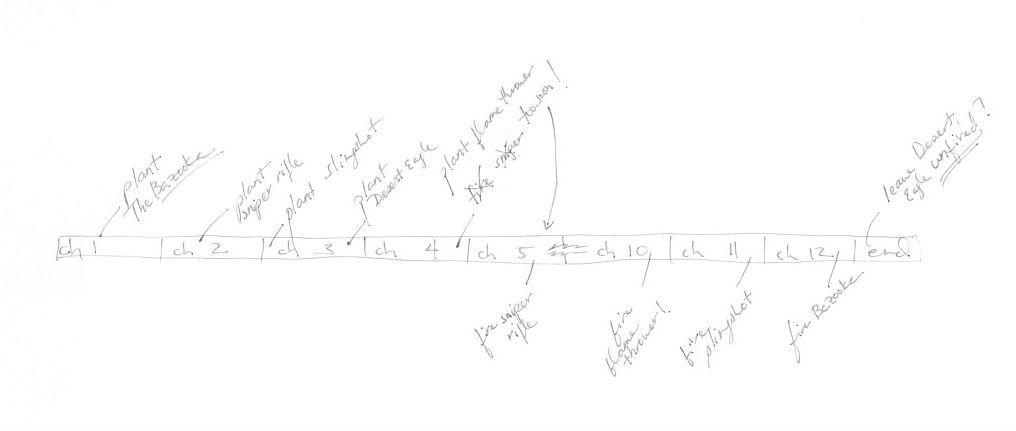
Click to embiggen. I think.


Let's call the overarching Promise of your story The Bazooka. You show a bazooka to someone, they'll remember it. This is The Prophecy in Harry Potter. Paul Atreides and the Gom Jabbar. Ender  whales on Stilson (coming to theaters 2013!). 

Cutey ptooty Asa Butterfield plays Ender Wiggin. Photo from IMDb.

 
Bazookas, right?

But that's not enough. In Dune, Paul gets a bunch of symbolic names: Usul, Muad'dib, Bene Gesserit Messiah. No one's firing The Bazooka yet. These are smaller guns being planted. The sniper rifle (Usul). The Desert Eagle (Muad'dib). The flamethrower (Messiah). 

He totes knew how to put on that suit. Photo from Dune Wikia.
 
Each gun has a specific purpose, an integrated storyline. But they all get fired at some point. And every time a planted gun is discovered, then fired, the story's getting street cred. "I showed you the rifle, the pistol, and the flamethrower. Then I fired them. You gonna stick around for when I bring The Bazooka out again?" F**k yeah. 

Fulfilling the little promises means you earn the reader's trust. I'm not thinking about putting your story down and fixing a sammich. I'm thinking: When is he going to fire that Bazooka? How? At whom? By whom? I have to know (because boy did crap explode when he fired that flamethrower!).

And now, let's take a look at your pistol-whipping problem. The guns (your Promises) are too obvious. They're not even mounted on Chekhov's wall at this point – actors are waving them around like it's New Year's Eve!

Here's something we can hide the guns with: a thesaurus. [Really great article on thesauri and connotations by Lois Levine (NY Times) found on @mainelarrycrane's twitter feed.]

Awfully generic sentence for us to deconstruct:
George walked in, carrying a bunch of flowers. – Totes neutral.

Superdeconstruct:
George – Protag
Walked in – neutral blocking
Carrying – pretty neutral verb
A bunch – totes vague
Flowers – totes vague
Consult thesaurus and reconstruct to foreshadow doom:
George strode in, bearing a knot of white lilies.
George strode in,[1] bearing[2] a knot[3] of white lilies[4].  
  1.   I can hear his heel strike ground, the howl of wind. The O in the middle makes me think Ominous. One doesn't stride up a wedding aisle. One strides when one has something important and unpleasant to do.
  2. This is one of my favorite words. To bear something means to carry it. But "bear" connotes that the thing being carried is a burden, something to be suffered, something to endure. "I cannot bear it!"
  3. Putting "bunch" into three online thesauruses (thesauri?) spit out hundreds of possible synonyms. Frex: bouquet. But what does that connote? IOW, what do you think of when you hear that word? Wedding? Doesn't exactly inspire doom. How about cluster? Say it out loud. Sounds almost… whimsical. How about knot? You hear the echo of its homophones, not (denial) and naught (emptiness)? And what does knot make you think of? A tangle. A puzzle. A problem.
  4. Here I went beyond the thesaurus and dipped into symbolism. Obvi, lilies mean death.
Now, though, it's almost too heavy. Let's change only a few neutral words and modernize it:

George came in, bearing a bunch of wilted lilies.
Even moar modern: George slumped in with a grip of crushed lilies.

Or change it to a happy event:
George sauntered in, carrying a bouquet of yellow roses. (I could have used camellias or birds of paradise as the symbolic flowers, but yellow roses are more commonly associated with friendship/love. Had I used the others, the gun would have been *too* well-hidden.)

In both examples, we kept the action intact but foreshadowed two different events by using words chosen for their connotations.

Next time you go through your WIP, Search and Destroy: vague narrative descriptions. Don't waste a chance to build tension with foreshadowing.

Happy writing and revising! I prophesy great rewards from your endeavors.
-J
 

Tweet me (@joanreginaldo) if you would like a particular writery subject discussed in a future post!

Coming Up:
It's not enough to have the gun at the end. Your character has to want to fire it.
Details
Purple Writing
Interview with Fantasy/Sci Fi artist Brian Mumphrey
Pacing
Verbing
Guest postage from author Robert Bevan


Monday, November 12, 2012

WRITER'S BLOCK


WRITER'S BLOCK

Or: [BAMF subtitle HERE]


Criticism looks like: "I don't know what to write next." Or "What happens next?" Or "The words just won't come!" 

The comments don't appear on your WIP because you haven't even finished your WIP! This is you, saying you have Writer's Block. 

Why am I writing about that instead of addressing a completed WIP? Cuz it's November! NaNoWriMo! Fellow Wrimo's are heading into the second(ish) week of the month, and I want to make sure they've got tools they can use. (Actually, anyone can use the techniques here at any moment in time.) So I'm not going to blog about Pacing, Details, Filtering, or our friends Showvee and Telle. Thinking about this schtuff might slow you down. Now is not the time to self-edit and self-criticize.

Write the damn story. Fix it in post. (And the more you revise, the better your first drafts get!)


Inspiration from the SF Zoo:
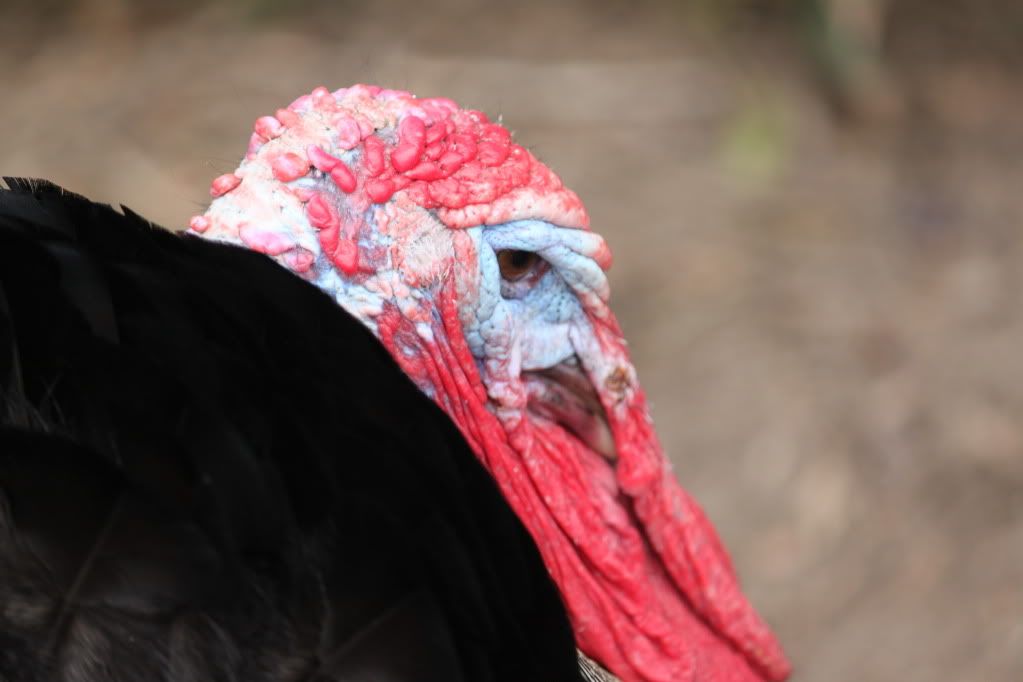
 "The Honorable Judge Jamison charged me with contempt after I called him a blue-faced, pustule-covered, sad, impotent, holiday main course."


Let me get opinionated for a mo. I don't believe Writer's Block exists. It's an inconvenience. Or, a convenient excuse. Like "I know what happens further on, but I don't know how to get there. I have Writer's Block." Or "I do know what happens next, but I don't know how to write it." Or simply "I have nothing to write." 


There's a Quick Fixes for two of three:
1. If you're stuck at a point in your story, but you know what happens just over the hump, in fact, you're aching to write what happens just over the hump, then f*cking skip the hump! Chances are, it's an eye-gougingly boring hump. "After Chester killed Mayor Bugaboo, he made himself a sandwich, disposed of the body, and confronted Mayor Bugaboo's sister." 

Do I need to see Chester making the damn sandwich? No. Do I need to know how he disposed of the body? Maybe. Do I want to see what happens when Chester confronts Mayor Bugaboo's sister? Hell yeah. Especially if she's gonna reveal something cray cray. 


Inspiration from real life:
"I had to take him home or be fired. The stakes were... high."

2. If you're stuck at a point in your story that's integral to plot/character/theme development and yes, by all that's holy it needs to be in the damn story but you don't know how to write an action scene/love scene/sex scene/murder scene, then use these buttons on your computer: [ and ]. Between those brackets, write: BAMF action scene/love scene/sex scene/murder scene HERE. 

Should look like: [BAMF action scene here] (BAMF stands for Bad*ss MoFo. Of, if you don't cuss, you can make up your own acronym. Like, Super Cute Awesome Terrific [SCAT murder scene HERE] or Incredibly Precious And Devastating [IPAD love scene HERE]. 

That's your placeholder. Continue writing and go back when you think you can do your scene justice. I know, I know, it's an awesome scene that will make people cry/laugh/go WTF just happened. But it's stopping you. It's a red light at a defunct intersection. SKIP IT. It's still going to be there when you're ready for it. 

 Inspiration from old family photo albums:
"Elves are born able to do fundamental magics. That's why they live in stone houses. Because of the tantrums."


When you're all done with your WIP, crack open the book of a master and find the necessary tools. Need to do action? What verbs did your fave author use? How were the sentences structured? Commas? Length? How about a love scene. How did your fave author convey the right emotions at the right time? Adjectives? Flashbacks? A murder scene could be a combination of the two. What senses were engaged? 

Point is, when doing a project, sometimes you do have to walk away from part of it until you've got the right tools. Might need a bone saw, might need quilling tweezers. Whatev. Specialty stores ain't open 24/7. Nothing wrong with that. An inconvenience.

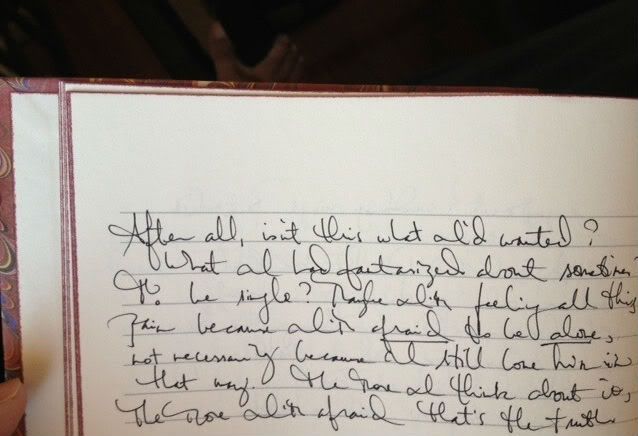
Inspiration from an incredibly self-indulgent emo journal entry.
"I think that's why the vampire chose me. Because I was emo too. Yes, I was emo too."

 Now, put your yoga pants on and let's get metaphysical:

It's so freaking easy to have a phrase for the blank page, the faltering plot, the strangely, suddenly silent character: Writer's Block! 

What do you really mean when you say it? Pin it down. Are you tired? Hungry? Sick of your protag? Realized how lame the BFF is? Completely unsure of where your story's going?

Sometimes, you do just need some rest, water, or a snack. Sometimes, you do just need to put in a placeholding [BAMF scene] here. Sometimes, though, you do need to take a break – not stop – from the story and find inspiration. Don't call it Writer's Block – a block is dense and implies difficulty. As a writer, you should be aware of a word's power. Call it a Writer's Pause. F*ck it, let's give it a badass name. 

I have Writer's [BAMF new name here]! 

This is you, giving yourself permission to be inspired rather than fooling yourself with an obstacle, a Block. The universe is full of inspiration. An old love letter. A journal entry. A riveting scene in an action movie. An article in Popular Science. A tabloid header. A meme. A word in the bible. Catastrophe. Castration. Empowerment. Rebirth.

Inspiration from everyday life:
I see at least 5 new themes to explore in this photo. How many can you find?


Ok, enough with the metaphysical pep talk.

Let's put our serious pants on: 
Here are some techniques (tested and approved by my writing group) you can use right now to get moving – maybe not in the direction you planned to go, but movement is movement. 

1.      Think: What's the worst thing that can happen to my protag? Make him face it/avoid it/outsmart it.

2.      Go back to the last decision your protag made and flip it.

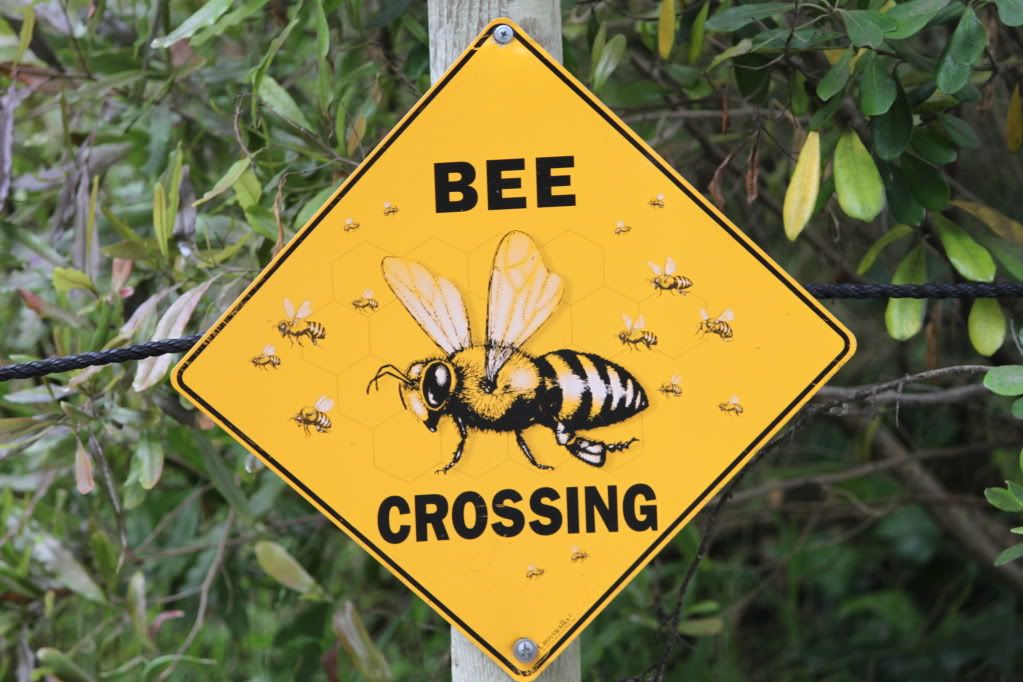
"At the Bee Crossing, Jakken considered going left. He went right instead. And his life was yadda yadda..."

3.      Go for a walk or take a hot shower. This is not a relaxing break. You're getting alone time with your characters. Talk to them. Find out why they won't act or speak or tell you what to write next. Maybe what happens next is so disturbing to your protag, he can't even talk about it. Seriously. You don't even want to know. But you have to know, so ask his friends (other characters in your story) what really happened. IOW, look at the scene from another POV.

4.      When you're wrapping up for the day, stop short. Don't push to the chapter's end. Or if you do, push into the next one. Don't leave the story where it feels good to leave it. Rather, stop just before you tie up a loose end, kill someone, whatev. That way, you have a scene in your head for your next writing session.

5.      [BAMF Obligatory don't give up message HERE]


Keep your chin up, Skippy. You're only playing with lives.
-J

Coming up: 
Details
Mssrs. Showvee and Telle
Pacing
Purple

Monday, November 5, 2012

GUEST: Robert Bevan

Guest Poster: Robert Bevan

On: Writing What You Want To Read,Self-Confidence, and 

Taking Criticism.


Warning: Guest poster cussage. 

So I was telling my good friend, beta partner, and author of the comic fantasy Critical Failures, Robert Bevan, that he should write a guest post for my writery blog. Now, let me infodump a mo here. Bobby and I have been friends for... a year now? Seems like more than a year. A few days ago, I was remembering how we first met and realized that beginning had a valuable message. So I said to Bobby, "Bobby, how did it feel when you first had the idea for CF?" 


Robert Bevan:
I first had the idea for Critical Failures while I was getting toward the end of an entirely unrelated novel that wasn't really falling into place like I thought it would. 

The climactic scene I was writing involved my characters being forced to act stupid in order for my own clever ideas to be implemented (hint: don't do that). And then I had a bunch of boring backstory I still had to dump on the reader in a Scooby-Doo-esque explanatory ending in order for a lot of things in the book to make sense in retrospect (hint: don't do that).


But I'd gotten that far, and I'd be damned if I was going to just abandon it unfinished to start up something new. If I let myself get away with that, I might never finish anything. So I rushed through a shitty ending and then abandoned it so I could start on the then yet-to-be-titled Critical Failures.


The bare-bones premise actually sounds kind of lame when I tell other people about it. A group of guys get transported into the world of their fantasy roleplaying game. For every person who was intrigued by that last sentence, another six people just went back to watching porn.

I got the same reaction when I told people what I was writing while I was writing it. "That sounds a lot like the old Dungeons and Dragons cartoon," they'd say. Yeah? Well it's nothing fucking like that.

So what do you do when you tell people about what you're writing and their eyes glaze over, or they actually come right out and criticize your idea. ("That's been done before." "So you're just writing out your D&D adventure?" "Stop licking me.") First and foremost, you should be doing more writing and less talking about it.

But you're excited about it, and writing a novel is a hard, lonely road. I get that. Sometimes you're going to want to talk about it.

So what do you do about the people who are obviously faking enthusiasm until they can find an escape from the conversation? You learn to pick up on that and then try to help them find their exit. They don't want to listen to you, and so you're not going to get anything useful out of them.

Hopefully you'll run into some people who are genuinely excited by your idea and gush about it. You don't really need advice for that; you know exactly what to do. Bask in that shit.


That leaves you with the people who are paying attention, but just aren't too keen on the idea for whatever reason... hopefully a reason which they will share with you. People who are willing to give you legitimate criticism, be it for your idea about your book, or any aspect of your life, are well worth listening to... at least initially. Take the criticism graciously, consider it thoroughly, and either accept or reject it.

For example, rejecting most of the initial criticism for my book's premise was easy, because I knew why people were criticizing it, and I knew that they were wrong in their preconceptions of what it was going to be. They fell mainly into two camps. People who thought I was trying to rewrite the old Dungeons and Dragons cartoon, and people who thought I was simply narrating the D&D adventure that I was currently playing with my friends. I was doing neither of these things. 

But don't let seemingly easy rejections go entirely unexplored. Rejecting Joan's advice to change the POV on my completed first draft manuscript from omni to limited third person seemed like a no-brainer. First of all, I thought it sounded just fine as it was. Secondly, fuck no! That's a shit ton of work to do. But she talked me into it, and it was, of course, the right thing to do.

And hell, even if your idea is lame, keep writing it anyway... at least until an idea comes along that you're absolutely one hundred percent certain you want to abandon your current project for. Writing something shitty is better than writing nothing. You've got to pound out some shit before you write something good anyway. Also, when you're typing through your lame shitty idea, you might be surprised at how often your characters will take the wheel and do something entirely unexpected and cool. In the end, you might find you have something worth salvaging. 

Keep writing.

Thank you, Mr. Bevan. -J

Robert Bevan can be contacted via Twitter and Facebook. His books and short stories can be found on Amazon.


Critical Failures  
"Cave of the Kobolds"
"ZOMBIE ATTACK!!!"


Next week: "In-spuh-ray-shun."