Showing posts with label Foreshadowing. Show all posts

Monday, December 10, 2012

DETAILS


DETAILS

Or: Pictures, or it didn't happen.


The comments: "This is totally generic." Or "This is boring." Or "I need more worldbuilding." 
What the comments mean: The story lacks (specific and unique) details.

Think of it this way: Pictures, or it didn't happen. Where's the proof?

In writing, you don't have the luxury of sharing a screenshot or instagram. The details you add to your descriptions supply that proof. When done well, you can prove your story happened

For example, when someone asks you, "Where were you last night?" 

How do you evade it? Easiest response would be vagueness. "I was out." Does this lead to the Questioner believing you, or not believing you?

More often, the vague response leads to: "Out where? With whom? Doing what?" The Questioner doesn't believe you and is asking for more proof. 

If you supply details as proof, the conversation might look like:
"Where were you last night?"
"I went to dinner with some work friends. We tried that new crepe place downtown. You know, the one on Castro Street. Across the street from the pet store with the giant gourami up front. It was so crowded though, we had to wait like, half an hour for a table."
"Oh yeah. I know that place."

Details gave the explanation truth (perhaps not the truth), just as they can in your writing. But! The details must be specific and unique. It was a crepe place, not a random restaurant. On Castro Street, not some random location. 

Paying attention to specificity and uniqueness in your WIP will help you:
1. Make your characters memorable.
2. Build a solid pocket universe.
3. Avoid clichés like the plague.
4. Make your story stand out.

Details convince a reader to believe you. Don't be evasive, coy, or vague. That leads to distrust. 

Now, if you're sure you're using enough descriptions, perhaps you're describing the wrong things. 

Describe through your characters. Treat it like one of those body-switching or suddenly-teen movie moments, and your protagonist is trying to convince the reader that s/he is who s/he claims to be: the hero, the saint, the World's Greatest Lover, the unstoppable evil. How? By describing things only s/he would know or notice. That's how s/he'll establish his truth, and that's how you'll establish yours.

Let's put our serious pants on and deconstruct an example from a limited 3rd POV with Wood Priestess Anna as our Protagonist:

When his name was called1 Shi came forward, tossing his curly ebony locks2, and bowed. He was tall3 and handsome4, with a gleaming sword5 at his side.6

1. This can be shown better.
2. Kill me now; "tossing his ebony locks?" First of all, who is he tossing these locks to? Secondly, purple prose cliché! Thirdly, whenever you're tempted to use "locks" to describe hair, understand why. Because it's been done so often that color + "locks" seems like the accepted way to describe hair – ebony locks, gold locks, scarlet locks. Do you want to be like everyone else, or do you want to stand out? (Second answer is correct.) 

3. As tall as what? This reveals almost nothing about the character being described or the POV character. What does tall mean in the story's pocket universe?

4. Same goes for handsome. Whose judgment is this? The POV character's? The writer's? Is this something you want the reader to feel about the character being described? Then give that character details that have meaning to the POV or main character

5. Gleaming? That's it? That's all I get about the sword?!

6. Overall, this is adequate for introducing someone who'll probably die soon.

Let's chisel him out of the crowd and breathe some life into him:

     The clarion bellowed the next person's name. "Shi Bautista!"
     Shi strutted forward1 then bent at the waist in what barely qualified as a bow. He was taller than the other Genians by at least a head, though shorter than any man, even most women, in the abbey hall2. With a wry grin and his sharp chin tilted up, he scornfully surveyed the room3. The sword at his side, secured to a low-slung belt by faded, knotted ribbons, slept in an ink-stained scabbard of cracked leather4.
     Anna leaned forward, body still and taught as a drawn bowstring5. Their eyes met and a strange tingle warmed her chest.

1. Specific and unique: Shi doesn't just "come forward." He struts.

2. When describing something that can be measured (ie. tall, wide) compare it to something relevant to the POV character.  Again, specific and unique. I have no f*cking idea how tall a Genian is but apparently, my POV character does. 

3. Have you ever been to a party where you didn't know anyone, and the hostess takes you around the room introducing you to people? Who did you remember? What specific and unique details made indelible impressions in your memory? Crooked nose, overplucked brows, lopsided grin, sadly sparse soul patch? Find those qualities in your characters and those details will separate your Super Spesh character from every other sidekick, Love Interest, and antagonist. 

4. Specific and unique. What does the state of his sword and scabbard reveal about him? Who uses ribbons to tie on a sword, for f*ck's sake? Why are there ink stains on his scabbard? And why is the leather cracked? Anna notices these details – which implies they're significant. The more details you add, the more important something seems. So for the love of all that's holy, don't spend too many details describing "the crowd" or "the room" or "the forest" or "the stranger" unless you intend to use them in a significant manner. 

5. And here's more "proof" that Anna thinks this is a significant moment. Character reactions (action or thought) will reveal what they think, and figuring this out is better than being told. Which is more satisfying: hearing your friend say "That librarian is so hot." Or watching your friend fidget, stammer, stumble, turn red, turn pale, or run away whenever the hot librarian is in sight and figuring it out for yourself? 

In your WIP: Replace the generic with specific and unique details. Caveat! Too many details can slow your pace. Beta readers would be helpful in pointing out where you need more/better details, and where to choose pace in favor of it. 

Happy writing,
J

Coming up: 
Pacing
Brian Mumphrey
Flat vs. Round Characters
Robert Bevan
Dialogue Tags

Monday, November 19, 2012

FORESHADOWING


Foreshadowing

Or: The Gun We Forgot to Plant


The Comments: "This is where I stopped reading and gouged my eyes out." Or "If I'd known you didn't have/weren't going to fire the gun, I would have stopped reading on page 5." Or "Deus ex machina!" 

What they mean: You didn't foreshadow (enough), which meant no suspense or tension. Or the climax is completely unbelievable (deus ex machina, aka: God from machine, aka never-before-mentioned item or character Divine Interventioned your protag's ass). 

There's a dramatic device called Chekhov's Gun, named for his comment, "One must not put a loaded rifle on the stage if no one is thinking of firing it." IE if there is a gun visible to the audience, there's an expectation, a promise, that it will be fired. That's the heart of foreshadowing: making a promise and fulfilling it.

Frex: With this super symbolic wedding ring, I promise Protag will live happily ever blah blah…
With this storm cloud looming on the horizon, I promise Protag's entire family gets slaughtered, and he has to Mad Max it up. 

If you've read a lot of your genre, you're already probably foreshadowing unconsciously as you write your first draft. Within the first chapter, did you put in a prophecy (fantasy)? Did you put in a new/wonky/not-quite-working-well engine part (sci-fi)? Did you put in a bad feeling/storm cloud/symbolic family heirloom (everything else)? That's foreshadowing. 

But! Here's the tricky part about foreshadowing. Sometimes it's so obvious, not only have you shown Chekhov's Gun, you're pistol-whipping the audience with it. In your WIP, does anyone say "What's the worst that could happen?" Or do you send your Protag out to face the baddie with no flashlight/wep or ridiculously unprepared with a TSTL sidekick/LI?

If writing in 3rd/1st Omni, how many times did you say something like "In retrospect, that's when things went bat-poop cray cray" or "and Bob's life was never the same yadda yadda"? 

Foreshadowing can also fizzle out. The gun is too vague (is that a gun in your pocket, are are you just etc?), or the length between showing it and firing it is too long. Frex: At the end of the story, when you do get around to firing it, it seems to come out of nowhere.

"But I totes planted it in the last paragraph of chapter 1!"
That was forty-five chapters ago, Skippy. I call deus ex machina!
 
How do you get around both these probs?

Let's put our serious pants on.

We'll start with the fizzle and work our way up to pistol-whipping.

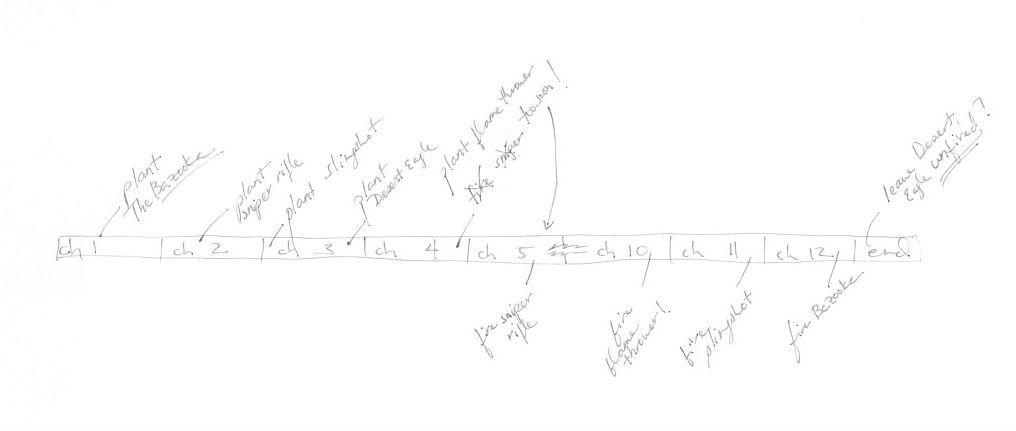
Think of it this way: Why have one gun when you can have a dozen different guns? And the bigger the gun, the stronger the impression. 

Click to embiggen. I think.


Let's call the overarching Promise of your story The Bazooka. You show a bazooka to someone, they'll remember it. This is The Prophecy in Harry Potter. Paul Atreides and the Gom Jabbar. Ender  whales on Stilson (coming to theaters 2013!). 

Cutey ptooty Asa Butterfield plays Ender Wiggin. Photo from IMDb.

 
Bazookas, right?

But that's not enough. In Dune, Paul gets a bunch of symbolic names: Usul, Muad'dib, Bene Gesserit Messiah. No one's firing The Bazooka yet. These are smaller guns being planted. The sniper rifle (Usul). The Desert Eagle (Muad'dib). The flamethrower (Messiah). 

He totes knew how to put on that suit. Photo from Dune Wikia.
 
Each gun has a specific purpose, an integrated storyline. But they all get fired at some point. And every time a planted gun is discovered, then fired, the story's getting street cred. "I showed you the rifle, the pistol, and the flamethrower. Then I fired them. You gonna stick around for when I bring The Bazooka out again?" F**k yeah. 

Fulfilling the little promises means you earn the reader's trust. I'm not thinking about putting your story down and fixing a sammich. I'm thinking: When is he going to fire that Bazooka? How? At whom? By whom? I have to know (because boy did crap explode when he fired that flamethrower!).

And now, let's take a look at your pistol-whipping problem. The guns (your Promises) are too obvious. They're not even mounted on Chekhov's wall at this point – actors are waving them around like it's New Year's Eve!

Here's something we can hide the guns with: a thesaurus. [Really great article on thesauri and connotations by Lois Levine (NY Times) found on @mainelarrycrane's twitter feed.]

Awfully generic sentence for us to deconstruct:
George walked in, carrying a bunch of flowers. – Totes neutral.

Superdeconstruct:
George – Protag
Walked in – neutral blocking
Carrying – pretty neutral verb
A bunch – totes vague
Flowers – totes vague
Consult thesaurus and reconstruct to foreshadow doom:
George strode in, bearing a knot of white lilies.
George strode in,[1] bearing[2] a knot[3] of white lilies[4].  
  1.   I can hear his heel strike ground, the howl of wind. The O in the middle makes me think Ominous. One doesn't stride up a wedding aisle. One strides when one has something important and unpleasant to do.
  2. This is one of my favorite words. To bear something means to carry it. But "bear" connotes that the thing being carried is a burden, something to be suffered, something to endure. "I cannot bear it!"
  3. Putting "bunch" into three online thesauruses (thesauri?) spit out hundreds of possible synonyms. Frex: bouquet. But what does that connote? IOW, what do you think of when you hear that word? Wedding? Doesn't exactly inspire doom. How about cluster? Say it out loud. Sounds almost… whimsical. How about knot? You hear the echo of its homophones, not (denial) and naught (emptiness)? And what does knot make you think of? A tangle. A puzzle. A problem.
  4. Here I went beyond the thesaurus and dipped into symbolism. Obvi, lilies mean death.
Now, though, it's almost too heavy. Let's change only a few neutral words and modernize it:

George came in, bearing a bunch of wilted lilies.
Even moar modern: George slumped in with a grip of crushed lilies.

Or change it to a happy event:
George sauntered in, carrying a bouquet of yellow roses. (I could have used camellias or birds of paradise as the symbolic flowers, but yellow roses are more commonly associated with friendship/love. Had I used the others, the gun would have been *too* well-hidden.)

In both examples, we kept the action intact but foreshadowed two different events by using words chosen for their connotations.

Next time you go through your WIP, Search and Destroy: vague narrative descriptions. Don't waste a chance to build tension with foreshadowing.

Happy writing and revising! I prophesy great rewards from your endeavors.
-J
 

Tweet me (@joanreginaldo) if you would like a particular writery subject discussed in a future post!

Coming Up:
It's not enough to have the gun at the end. Your character has to want to fire it.
Details
Purple Writing
Interview with Fantasy/Sci Fi artist Brian Mumphrey
Pacing
Verbing
Guest postage from author Robert Bevan